Published ·By the InayaFlow team ·7 min read
How to Go Viral on TikTok: What Is Real and What Is Luck
No one can promise a viral TikTok. Here is what TikTok says decides reach, how often outliers happen in our data, and a 6-step test plan.
You cannot make a TikTok go viral on demand, and TikTok publishes no formula for it. What you can do is make a video that keeps a stranger watching, make its topic easy to place, and post enough different attempts to learn what works for your account. In our data of 213 channels, 28% had a breakout video at ten times their usual median or higher, so it does happen to small accounts.
Try it on your own account: type a TikTok username to see its engagement rate from its recent videos.
Engagement rate by views
—
Add your likes, comments, shares or saves.
Engagement rate by followers
—
Add your likes, comments, shares or saves.
Want to know why your TikTok numbers look like this?
Type your TikTok username and InayaFlow compares your own recent videos: your typical views, your engagement rate, what is working and what to post next. Free, no account or password needed.
Open the full TikTok engagement rate calculator.
Key takeaways
- TikTok Newsroom: the number of followers you have, and your past hits, are not direct inputs to the For You feed, so a small account can have a video that spreads.
- Our 2026 dataset (213 channels): 28% of channels had a breakout video at ten times their usual median or higher, so breakout videos are fairly common, though never certain.
- Our dataset: the median video got 280 views, and a channel's top video carried a median 23% of its total views.
- TikTok publishes no formula for going viral. It lists signals such as watch behavior, video information and your interactions, and notes that a video's results build up over about two days.
- Pew Research (2026): 37% of US adults use TikTok, 63% of those under 30, so the audience is large but each viewer's feed is personal.
On this page
This guide is about spread, meaning a video reaching people who do not follow you. If you want the full list of everyday fixes, go to the main guide on TikTok views. If your reach has dropped, read why your TikTok views are going down.
Going viral at a glance
| Topic | What we know | Origin |
|---|---|---|
| Does TikTok define viral? | No. There is no official view count | The recommendation pages we read give no view count for it |
| Do you need followers first? | No, TikTok does not list it as a direct input | TikTok Newsroom |
| Do #fyp hashtags help? | No more than any other hashtag | TikTok Newsroom |
| How common are outlier videos? | 28% of channels had a 10x video | Our 2026 study |
| How long should you wait before judging? | A couple of days | TikTok Newsroom |
What "viral" means (and what TikTok does not say)
TikTok does not set a number for viral. Its recommendation pages describe how videos are chosen for each viewer, not how a video becomes famous. TikTok's Newsroom page on recommendations says the system also learns what is popular among a wider range of audiences, but it never says how a video reaches them.
So pick your own definition. A sensible one is 10 times your median views. Take your last 10 videos, find the middle number, and multiply it by 10. In our 2026 dataset the median video got 280 views, so 2,800 views would be a viral-sized jump for that typical channel (InayaFlow study). Your median may be higher or lower, and it is the only number that tells you whether a video broke away from your normal.
How TikTok decides who sees a video
TikTok's Transparency Center says the system gives each video a prediction score for each viewer, and the highest-scoring videos make the feed. The page lists the inputs: the viewer's profile and device, their activity such as videos watched, finished, liked or skipped, their follow relationships, and video attributes such as when and where it was posted, the language, the soundtrack, the length and the hashtags (TikTok Transparency Center).
Two points follow if you want spread:
- The decision is made per viewer. A video is not "pushed" to everyone. It is matched to people whose past behavior suggests they will like it.
- Your follower count is not a direct input on its own. TikTok's Newsroom says your audience size and earlier hits do not feed the system directly, though it adds that accounts with more followers tend to see more views (TikTok Newsroom).
The audience is big: Pew Research found 37% of US adults use TikTok, including 63% of those under 30 (Pew Research Center), but each person's feed is personal. For the full picture of the feed, see our guide to the TikTok algorithm.
What our data says about viral videos
TikTok shares no spread data, so we use our own. We studied 213 channels and 3,422 videos run between June and November 2026 (InayaFlow study). They come from creators who tried our free analysis, so they are not a picture of all TikTok.
| Measure | Result in our data |
|---|---|
| Median views per video | 280 |
| Middle half of videos (25th to 75th percentile) | 160 to 530 views |
| Videos that beat their own channel median | 47.6% |
| Channels with a video at 10x their median or more | 28% |
| Share of a channel's views from its top video (median) | 23% |
Three lessons from these numbers:
- Half of your videos will land below your median by definition. Do not read one weak post as a failure.
- One hit usually carries a large share of the total. If your top video holds about a quarter of your views, your growth comes from finding and repeating hits, not from raising every video a little.
- Most channels did not have a 10x video in this sample. 72% did not, so plan for many attempts.
Do hashtags, length or posting time make a video go viral?
In our data, not on their own. Videos with 3 to 5 hashtags had a relative-views median of 1.0, the same as videos with none. Video-length groups from under 15 seconds to over 3 minutes also centered on 1.0 against each channel's own median (InayaFlow study). That fits what TikTok says: "More hashtags won't guarantee a broader reach", and that #FYP is handled like any other tag (TikTok Newsroom).
TikTok adds that vertical framing and clips beyond five seconds do best. Treat those as the floor, not a trick.
Seven things that raise your odds
None of these is a guarantee. They are the levers that TikTok's own pages and our data point to.
1. Win the first seconds
Viewer activity such as watching, finishing or skipping is an input in TikTok's system. A first line that names the payoff gives a stranger a reason to stay. Our guide to TikTok hooks has patterns to test.
2. Make the topic obvious
The recommendation system reads the details attached to a video: its caption, sound and hashtags. If the topic is clear in the first line, on screen and in the caption, the system has more to match against the right viewers.
3. Aim at one viewer
A video made for "everyone" is a match for no one. Pick one person, say a beginner baker or a new gym-goer, and speak to that person.
4. Reuse what already worked
If a video beat your median, make a close cousin: the same topic, a different angle, a fresh first line. TikTok's feed generally won't show two videos in a row made with the same sound or by the same creator, so a series is shown spaced out, but each post is a new chance.
5. Keep sound and effects relevant
TikTok's creator tips say popular audio and trending hashtags can help videos get discovered and shared. Use them only when they fit the video.
6. Post enough to learn
TikTok says posting volume does not alter recommendations, so frequency is no lever by itself. Posting enough to test ideas is. A rhythm you can keep is better than a burst you cannot.
7. Judge after a couple of days
TikTok's creator tips say results accumulate over about two days. Check then, not after an hour.
A 6-step test plan for the next 2 weeks
- Find your median. Take your last 10 videos and write down the middle view count.
- Mark your best video. Note its topic, first line, length and sound.
- Make three close cousins of that video with different first lines.
- Make two new-topic tests in the same niche so you do not only repeat.
- Wait two days per video before scoring it against your median.
- Keep the winners. Any video above 2 times your median becomes a template. Above 10 times is a hit.
You can compute rates for your own videos with the free engagement rate calculator.
Common mistakes
- Buying "viral" tricks. Hashtag stacks and #fyp tags do not change reach, per TikTok. Hashtags will not make a video viral; how many hashtags to use, and what our data shows, is in a separate guide.
- Chasing the last viral sound. Trends help only when they fit your topic. A trend only helps if it fits your video: check the current top hashtags on TikTok before you borrow one.
- Judging after an hour. Results accumulate across about two days.
- Copying a hit video exactly. TikTok's feed avoids repeating the same sound or creator back to back.
- Quitting after 10 videos. In our sample 72% of channels had no 10x video, so one dry stretch says little.
- Ignoring a drop. If your reach falls after a hit, see why TikTok views go down.
How InayaFlow helps you find your own hits
The hard part of a test plan is knowing which of your videos beat your normal and why. InayaFlow reads the public numbers on each video (views, likes, comments, shares, saves) along with the words spoken in your videos where a transcript exists, then writes up what your top videos share.
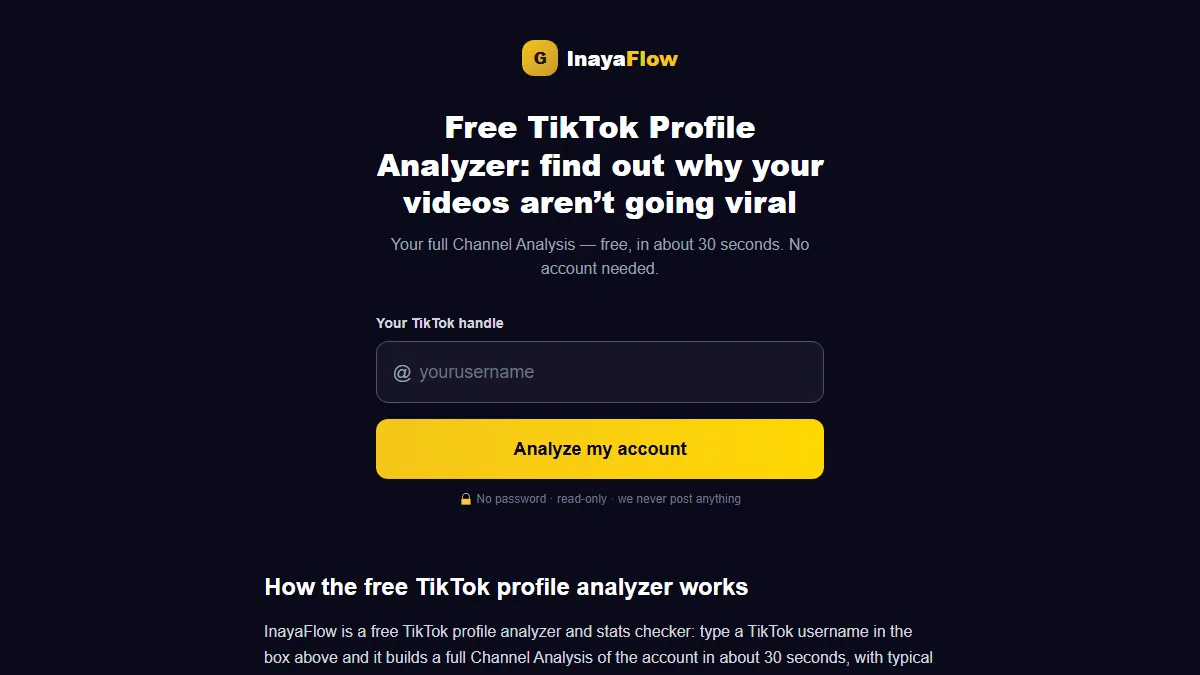
Type your handle at the free TikTok channel analysis and the result arrives in under a minute: your niche, strengths, weaknesses and three recommendations, with no password and no account. Pro adds Content Ideas, Write My Script and Video Analysis, where you paste a video and see what drove its result. It reads neither watch time nor retention; TikTok Studio holds those. Posting stays with you.
Going viral checklist
- I know my median views from my last 10 videos.
- I picked one viewer and one topic for the next video.
- My first line names the payoff.
- I did not rely on #fyp or on stacks of hashtags.
- I made a close cousin of my best video.
- I will wait two days before judging the post.
Want a second read on which of your videos are doing the work? Try the free channel analysis. For rates on your own numbers, use the engagement rate calculator.
Frequently asked questions
How do you go viral on TikTok?
Nobody can promise it, and TikTok publishes no formula. What you can do is raise the number of chances: post videos that keep a stranger watching, make the topic obvious, and test one change at a time. In our data of 213 channels, 28% had a breakout video at ten times their usual median or higher.
How many views is viral on TikTok?
TikTok does not define viral. A useful personal test is 10 times your median views. In our 2026 dataset the middle video had 280 views, so ten times that is 2,800, but your own median is the number that matters.
Can you go viral on TikTok with no followers?
Yes, it is possible. TikTok's Newsroom says the size of your following is not a direct input to the For You feed. TikTok also notes a video is likely to get more views from an account with more followers, so expect an easier path with an audience, not an impossible one without.
How long does it take for a TikTok to go viral?
TikTok's creator tips say a video's results build up across roughly two days, so hold off before judging a post. TikTok does not give a time for a video to spread, and a video can be recommended for a long time after posting.
Do hashtags like #fyp make a video go viral?
No. TikTok says that #FYP, #ForYou and #ForYouPage work like any other hashtag and will not reliably place a video in For You feeds. In our data, videos with 3 to 5 hashtags had about the same relative views as videos with none.
Does posting more often help a video go viral?
Per TikTok, posting volume does not alter how your content is recommended. More posts mean more tests, yet each video is scored on its own.
Sources
- TikTok Transparency Center: Recommendation system (November 16, 2026)
- TikTok Newsroom: How TikTok recommends videos #ForYou (June 18, 2020)
- TikTok Newsroom: 5 tips for TikTok creators (July 30, 2020)
- Pew Research Center: 8 facts about Americans and TikTok (March 2, 2026)
- InayaFlow: TikTok benchmarks study 2026 (213 channels) (November 10, 2026)