Published ·By the InayaFlow team ·11 min read
Does the First Hour Matter on TikTok? What Is Known and What Isn't (2026)
Does the first hour decide a TikTok's reach? See what TikTok says, what the data shows, a 60-minute checklist and how to log your own first-hour numbers.
The first hour matters because it is when most early engagement arrives, but TikTok has not published any rule that says the first hour decides a video's reach. TikTok says engagement on a new video generally peaks soon after publishing, and that a video keeps performing across a couple of days. Anything sharper than that, such as a 60-minute test or an exact threshold, comes from creator blogs, not from TikTok.
Try it on your own account: type your TikTok username for a free report on your recent videos.
Key takeaways
- TikTok Newsroom (30 Jul 2020): engagement on a new video usually peaks soon after publishing, and the video keeps earning for a couple of days. TikTok gives no number for the first hour.
- Buffer (7.1M posts, Sep 2026) says the first hour or so is the key window. That is Buffer's reading, not a TikTok statement, and the sources we read disagree on how long any test lasts.
- TikTok Transparency Center: the recommendation system weighs viewer signals such as watches, finishes, likes and skips, plus video details. It names no test audience or time limit.
- InayaFlow viral study (10,124 trending US videos): the 766 videos over 1M views had a median age of 5.9 days when we measured them and only 21.1% were within 3 days, so the study cannot show how much of those views came in the first hour or day (age is measured when we read the count).
- Treat the first hour as the time to be present, not the time you can fix a weak video. Judge a video after about two days.
On this page
This guide separates what is known from what is theory, gives you a 60-minute checklist for posting day, and shows how to log your own first-hour numbers so you can see whether it matters on your account. It sits under our main page on how to get more views on TikTok.
What TikTok actually says
TikTok has said three things that bear on the first hour.
- Engagement peaks early and runs for days. In its "5 tips for TikTok creators" post, TikTok says engagement on a new video peaks soon after publishing and that performance carries on for a couple of days (TikTok Newsroom, 30 Jul 2020). It names no hour count.
- Your posting volume is not a recommendation factor. The same post says how many videos you post has no effect on For You recommendations. That means posting more to chase the first hour does not help by itself.
- The system scores signals, not a clock. The Transparency Center describes a recommendation system that scores each video on how likely it is to be liked, shared, commented on or skipped, then ranks videos by an overall score (TikTok Transparency Center). It describes no test audience, and it is silent on what happens to a video that has no engagement yet.
So the TikTok-backed version of "the first hour matters" is modest: early engagement is when most of it happens, and the video carries on afterward.
What other sources claim
| Claim | Who says it | Is it TikTok's? |
|---|---|---|
| "Especially within the first hour or so" a small group's reaction decides whether reach widens | Buffer (Sep 2026) | No, Buffer's reading |
| The seed-testing phase lasts roughly 24 to 72 hours | NoobClaw (Aug 2026), no source given | No, NoobClaw calls it "not an official TikTok specification" |
| TikTok has not confirmed a fixed first-hour test or a threshold that guarantees reach | Stackademic (Nov 2026) | A fair summary of what is public |
| Completion rate needs to rise from about 50% to 70% | NoobClaw, "several 2026 analyses" unnamed | No, and we could not trace it |
The fair summary is that creators and tools broadly agree early engagement helps, but they do not agree on a window, and no source we read could cite a TikTok document for one. The ranges are 24 to 72 hours in one article and "the first hour or so" in another, which cannot both be a hard rule.
Why a fast start can still help
Without claiming a mechanism, there are three honest reasons early engagement is worth caring about.
- The first viewers are a sample. If a handful of viewers watch to the end and a few comment, you learn quickly that the opening works. If they swipe away within seconds, you learn that too.
- Signals add up. TikTok lists watches, finishes, likes, shares, comments and skips among the interactions that feed predictions. A video that earns more of them sooner has more to show in each check.
- You can respond. Replying to early comments is something you can do while viewers are still there. It is a way to start a conversation, not a documented ranking factor.
None of that makes the first hour a deadline. It makes it the best time to watch what happens.
What the data says about slow starts
Our viral study of 10,124 trending US videos shows the age of viral videos: the 766 that passed 1M views had a median age of 5.9 days when we measured them, and 21.1% were within 3 days of posting. Age is measured when we read the view count, not when the views arrived.
| Number (US trending videos) | Value |
|---|---|
| Videos that passed 1M views | 7.6% (766 videos) |
| Median age of those videos when we measured them | 5.9 days |
| Share of those videos within 3 days of posting | 21.1% |
| Share of those videos within 7 days of posting | 60.2% |
Two things follow. First, the median viral video was 5.9 days old when we measured it, so most of these counts were read well after the first hour. Second, 21.1% were within 3 days of posting, so fast starts happen too, though this study cannot tell you when in a video's life the views arrived. It is a sample of trending videos found through searches, not all of TikTok, and it shows patterns, not causes.
If views are flat for several days rather than for one slow hour, our guide on falling TikTok views is the next read.
Does posting time change the first hour?
Posting when your followers are active is the only first-hour lever with some data behind it. Buffer analyzed more than 7.1 million posts. Its top slot was 9 a.m. on Sundays, then 1 p.m. on Mondays and 1 p.m. on Sundays. Evenings from 6 p.m. to 11 p.m. generally scored highest on engagement, and afternoons lowest on most days (Buffer, 14 Sep 2026). Buffer notes the time is only one factor, and says other studies found different best days.
Treat those slots as a place to start, not a rule for your audience. Your own followers' active hours sit in TikTok Studio, and our best time to post guide shows how to read them. For a quick general window, try our free timing tool for today; a window built from your own videos needs your own data.
A 60-minute checklist for posting day
These steps are our suggestion, built from the early-engagement theory above. TikTok does not require any of them.
Before you post
- Check the first 2 seconds. TikTok's Newsroom says grabbing attention early and keeping it makes a video watchable and shareable. Our hooks guide has openings to test.
- Write the caption for a stranger. Say what the video is about in plain words. TikTok says details like the caption, sound and hashtags feed its recommendations (TikTok Newsroom).
- Pick a time you can be around. A fine slot you can watch beats a perfect slot you miss.
In the hour after posting
- Check it published properly. Confirm the video plays, the cover looks right and the caption has no typo.
- Reply to early comments. Answer with a real sentence. Questions in the comments are also ideas for your next video.
- Share it where your people already are. A message or story to followers who care about the topic is fine. Do not trade likes or buy views, because it hides what the video really earned.
- Do not edit or delete in a panic. Changing a video because the first 20 minutes are slow throws away the days it has to perform.
After the hour
Write down three numbers at one hour, 24 hours and 48 hours: views, comments and shares. That is the start of your own first-hour log, below.
How to test whether the first hour matters on your account
Most advice on this topic is a theory, so run a small experiment on your own channel. Use your next 10 videos.
| Video | Views at 1 hour | Views at 24 hours | Views at 48 hours | 1 hour as a share of 48 hours |
|---|---|---|---|---|
| 1 | ||||
| 2 |
After 10 videos, check two things:
- Does a strong first hour predict a strong 48 hours? If the videos with the most views at one hour also finish on top, early engagement is a good signal on your account.
- Do some videos start slowly and finish well? If yes, a quiet hour is not a verdict for you.
Keep one fact in mind: this log reads your public numbers, and TikTok Studio holds the details such as watch time. TikTok Studio analytics shows how to read them.
If the first hour goes well
A fast start is encouraging, but it is not a result yet. Keep your reaction proportionate.
- Do not change anything. Leave the video, caption and cover alone. Editing a caption mid-run only muddies what you learn.
- Keep replying. Strong early comments are the best source for the next idea, and replies keep the conversation going while people are still arriving.
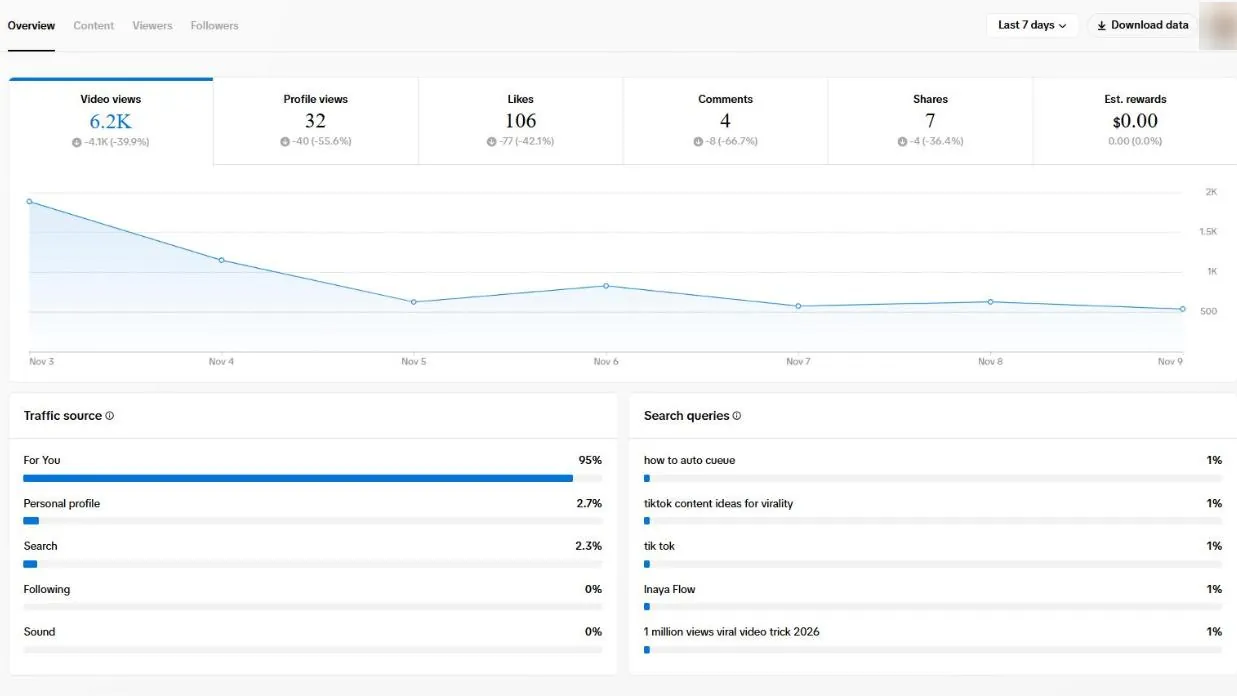
- Check the traffic source. Views mostly from followers reflect loyalty. Views mostly from For You reflect reach.
- Do not copy it blindly. One video that starts well may be a lucky topic, a lucky time or a single share. Make a similar one and see whether it repeats. In our viral study, 94.2% of the 707 US creators with a 1M+ video had exactly one in the sample, so single winners are common and easy to over-read.
- Write it in your log. A good hour only becomes useful when you can compare it with nine others.
Which numbers to watch in the first hour
Not every number deserves your attention in the first hour. TikTok's Transparency Center lists the viewer behaviors its models predict: likes, shares, comments, "Not interested" marks, profile visits, follows, finishes, skips, favorites, watch time and soundtrack taps (TikTok Transparency Center). You can see some of these and not others, so here is what to check.
| Signal | Where you see it | What it tells you early |
|---|---|---|
| Views | On the video and in TikTok Studio | Whether the video is being shown at all |
| Likes, comments, shares | On the video | Whether early viewers reacted, and comments show what they asked |
| Average watch time | Per-video analytics in TikTok Studio | Whether the opening and the middle hold people |
| Traffic source | TikTok Studio overview | Whether views come from For You or only from your followers |
| Profile visits and follows | TikTok Studio | Whether the video made a stranger curious about you |
Look at average watch time and the traffic source before you look at likes. A video with modest views but a long average watch time has a good middle and a weak reach problem, and a video with plenty of views but a short watch time has the opposite. Our guide to reading TikTok analytics explains where each number sits. Skips and "Not interested" marks are not visible to creators, which is one more reason to treat any first-hour reading as partial.
Small accounts and large accounts
The first hour looks different depending on who follows you. If you have a few hundred followers, the people who see your video in the first hour may be mostly strangers, so the hour tells you how the video does with people who do not know you. If you have a large following, many of the first views may come from followers, and a strong hour can reflect loyalty more than reach. TikTok says your follower count is not one of the direct inputs to recommendations (TikTok Newsroom, 18 Jun 2020), but your followers are still part of the audience that sees a new video. That is why the traffic source panel matters: it separates the two.
What to do with the result
The point of watching the first hour is to make a better next video, not to rescue this one. After 48 hours, sort your last 10 videos by views and put the top three and bottom three side by side. Compare the first two seconds, the caption, the length and the post time. If the top three share an opening style, that is your next test. Our guide to analyzing a viral TikTok gives a seven-step teardown you can run on your own best video, and how to go viral on TikTok explains why one hit rarely proves a method.
Why a video can stop getting views
A video that gets most of its views in the first hours and then stalls is common, and the cause is usually not the clock. Check these in order:
- The opening. If viewers leave in the first seconds, the later parts never get seen.
- The topic match. The video may be reaching viewers who do not care about it, which shows up as skips.
- Eligibility. TikTok says content that is not suitable for a broad audience can be made ineligible for recommendation (TikTok Transparency Center).
- A view-count freeze. If every video stops at the same number, see why TikTok gets no views and our shadowban guide.
Should you delete and repost?
No TikTok page we opened says it helps, and TikTok's line on posting volume suggests more posts do not change recommendations by themselves. The cleaner move is to wait about two days, then if the video truly missed, remake it with a new opening line and caption and post it as a new video. Do not delete a video just because the first hour was quiet.
Common mistakes
- Judging at 60 minutes. TikTok says a video earns for a couple of days after posting.
- Buying or trading engagement. It tells you nothing true about your video, and no TikTok page we opened says it helps.
- Posting at the perfect time while you are asleep. You lose the chance to reply early.
- Copying one study's best slot. Buffer says other studies disagree, and your audience is not theirs.
- Changing three things at once. Change the opening or the time, not both, or you will not know what worked.
How InayaFlow helps with posting day
Checking the first hour is easier when you already know where your channel stands. You can start the free Channel Analysis with just a handle and no password; it works from your public videos. It shows your best video next to a typical one, which gives you a fair yardstick for judging a new video, and it flags one strength and one thing to improve first. Free sign-up with no card shows the whole report.
For timing, the best time to post today tool offers a general benchmark window, and on Pro, Best Posting Times lists eight 3-hour windows per weekday from your own top videos. Content Ideas and Write My Script give you an idea and a draft ready before posting day. Nothing in InayaFlow reads watch time or your TikTok Studio data, it never posts for you, and it promises no result.
Next step
Next time you post, stay near your phone for the first hour, then note views at one hour, a day and two days. To get your yardstick first, run the free Channel Analysis.
Frequently asked questions
Does the first hour matter on TikTok?
It matters as the time when most early engagement arrives. TikTok's Newsroom says new videos generally peak in engagement soon after publishing and keep performing for a couple of days. It publishes no first-hour threshold, so a slow hour is not a verdict.
Is there a TikTok test audience in the first hour?
TikTok's Transparency Center page describes no test audience and no time window. Buffer and several creator blogs describe one, but the NoobClaw article we read says its version is not an official TikTok specification. Treat it as a working theory.
Should I delete and repost a video that gets no views in the first hour?
No TikTok page we read says deleting and reposting helps. Since performance runs over a couple of days, give it about 48 hours first. If you repost, change the opening line and the caption instead of posting the same video again.
What should I do in the first hour after posting?
Be around to reply to comments, check that the caption and cover look right, and share the video where your followers already are. Do not buy views or ask for fake likes. None of it is a TikTok requirement, and none is promised to raise reach.
How long should I wait before judging a TikTok video?
About two days. TikTok says results from a video arrive over a couple of days. Compare the video's views with the median of your last 10 videos rather than with your best one.
Can a TikTok go viral after the first hour?
Yes. In our viral study the median video over 1M views was 5.9 days old when we measured it, and TikTok says performance carries on for days. Our data only records age when we read the count, not when views arrived, so it cannot tell us how many of these videos started slowly. TikTok's own description of performance continuing for days is the better reason not to judge a video on its first hour.
Sources
- TikTok Newsroom: 5 tips for TikTok creators (July 30, 2020)
- TikTok Transparency Center: Recommendation system (November 23, 2026)
- Buffer: Best time to post on TikTok in 2026 (September 14, 2026)
- Stackademic: How TikTok Engagement in the First Hour Shapes a Video's Reach (November 17, 2026)
- NoobClaw: TikTok First-Hour Engagement: What to Track and Compare (August 15, 2026)
- InayaFlow: InayaFlow viral TikTok study 2026 (22,767 trending videos) (November 27, 2026)